
An action tank for the democratisation of wealth
Size Matters, but So Does Allocation: A Study of Whether Institutional Investment Boosts European Capital Market Development

Our Executive Director, David Pinkus, recently co-authored, with Marie-Sophie Lappe from Bruegel, a study on the investments of EU insurance companies and pension funds and capital market development.
The EU has relatively small and fragmented capital markets, which creates challenges for investment and economic growth. From business C-suites to Brussel policymakers, the quest for larger and more efficient capital markets is an important issue across the European Union and our study looked at the role EU-based insurance companies and pension funds (the ICPF sector) can play in meeting that challenge.
The research shows that the issue for EU capital markets is not a lack of potential capital. It is how that capital is invested.
Bias towards currency and deposits
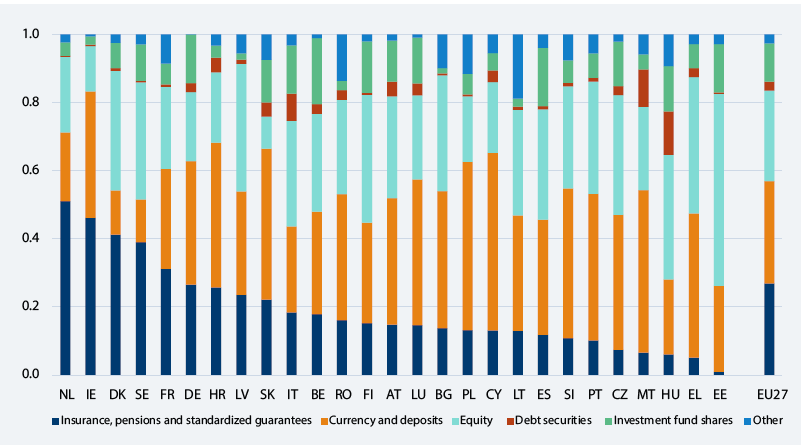
The Figure below shows how European households heavily save in currency and deposits. Fostering more funded pensions in the EU instead presents an opportunity to put more savings in the hands of professional institutional investors, that in general can achieve better outcomes than individuals when investing. Furthermore, more countries moving towards funded pensions would help mitigate the financial pressure on pay-as-you-go pension systems stemming from population ageing.
Figure: Financial assets of households, by type of asset, share, 2025-Q3
Source: Lappe & Pinkus (2026)
How pension savings are invested matters
But not only the size of pension savings in the EU will matter for capital market development, rather also how these are invested. In earlier work, we disentangled the asset allocation of EU ICPFs.
We found that over half of assets are invested in bonds (both EU and non-EU issued). Therefore, effects of more funded pensions could be different for stock and bond markets. Importantly for the conversations in Brussels around developing equity and bond markets, asset allocation of ICPFs needs taking into account.
Benefits from both size and allocation
Most of the research (see the full paper for an in-depth review) on the relationship between funded pension savings and economic growth or capital market development focuses on the size of the sector, rather than asset allocation of the sector. There is a good reason for this, namely that data on ICPF asset allocation is very difficult to obtain.
Our recent research aims to investigate the importance of asset allocation on a range of macroeconomic outcomes such the size of equity and bond markets, stock market volatility and bank financing.
To summarise our results, we find that both size and investment in domestic equity matters for the size of domestic stock markets. The relationship between domestic investment and market size is stronger for bond than for equity markets. Lastly, we do not find any significant relationship between ICPF investment and market returns, volatility or reliance of the economy on bank lending.
Policy implications
The finding that both size and asset allocation matter for stock market development has meaningful policy implications. Growing the ICPF sector, for instance by expanding funded pension systems, could contribute to deeper capital markets; however, ensuring that the resulting assets are channelled into productive investments is equally as important. The results also suggest that the ICPF sector contributes to equity market development beyond directly channelling savings into the market, since we find that both size and asset allocation matter.
However, investing in the interest of savers, the future pensioners, needs to remain the primary consideration of ICPFs when they invest.
The paper stresses that the primary obligation of the ICPF sector is to its savers, and therefore its results do not support mandating domestic equity investment for the purpose of domestic capital market growth. Rather, promoting funded pensions through automatically enrolling savers, for example, alongside measures to increase attractiveness of investing in EU capital markets, will likely support capital market development in the EU.
Removing barriers to equity investment deserves close attention from policymakers, alongside efforts to grow the sector overall.
Taken together, the findings support the broad direction of EU policy efforts to channel household savings more effectively through the ICPF sector, while underscoring that the productive potential of this shift depends critically on how those savings are ultimately invested.
EU policymakers should work towards growing the ICPF sector, while carefully designing an environment that promotes investment into productive assets. ---
Written by:

Dr. David Pinkus
Executive Director
Sign up for news and updates
The Coller Pensions Institute is part of the Jeremy Coller Foundation