
An action tank for the democratisation of wealth
Saving for Retirement, Insuring Against Longevity

Today the UN marks the International Day of Older Persons and celebrates one of humanity’s greatest achievements: that humans are living longer than ever before. But the day is also about raising awareness of the challenges that come with this, and longer life expectancy is changing the economics of retirement, especially for countries still moving through the demographic transition.
Many pension systems were designed when retirement was shorter and survival to very advanced ages was less common. Old-age income protection therefore had a strong insurance logic: reaching very old age was uncertain, but financially costly for those who did.
That world has changed first in advanced economies. Across OECD countries, life expectancy at age 65 rose by about six years between 1970 and 2021. In 2024, a 65-year-old in the OECD could expect to live a further 20 years on average. Developing economies are moving in the same direction, but often with lower pension coverage and less fiscal space.
The question is how the balance between saving and insurance should evolve?
The pension challenge is arriving at different speeds
Advanced economies offer a warning and an opportunity. As people spent more years in retirement, systems designed around earlier demographic conditions came under pressure. Governments, employers and households had to finance benefits over longer horizons, while retirement ages often moved more slowly than survival probabilities.
Developing countries may have less time to adjust. In a sample of current OECD countries with long historical records in the Human Mortality Database (HMD), the median country reached a 7% share of people aged 65 or over around 1930 and took about six decades to reach 14%. The latest share is about 20%. In a sample of emerging economies using UN World Population Prospects 2024, the median country reaches 7% only around 2018, but is projected to reach 14% around 2041, a transition of roughly one generation.
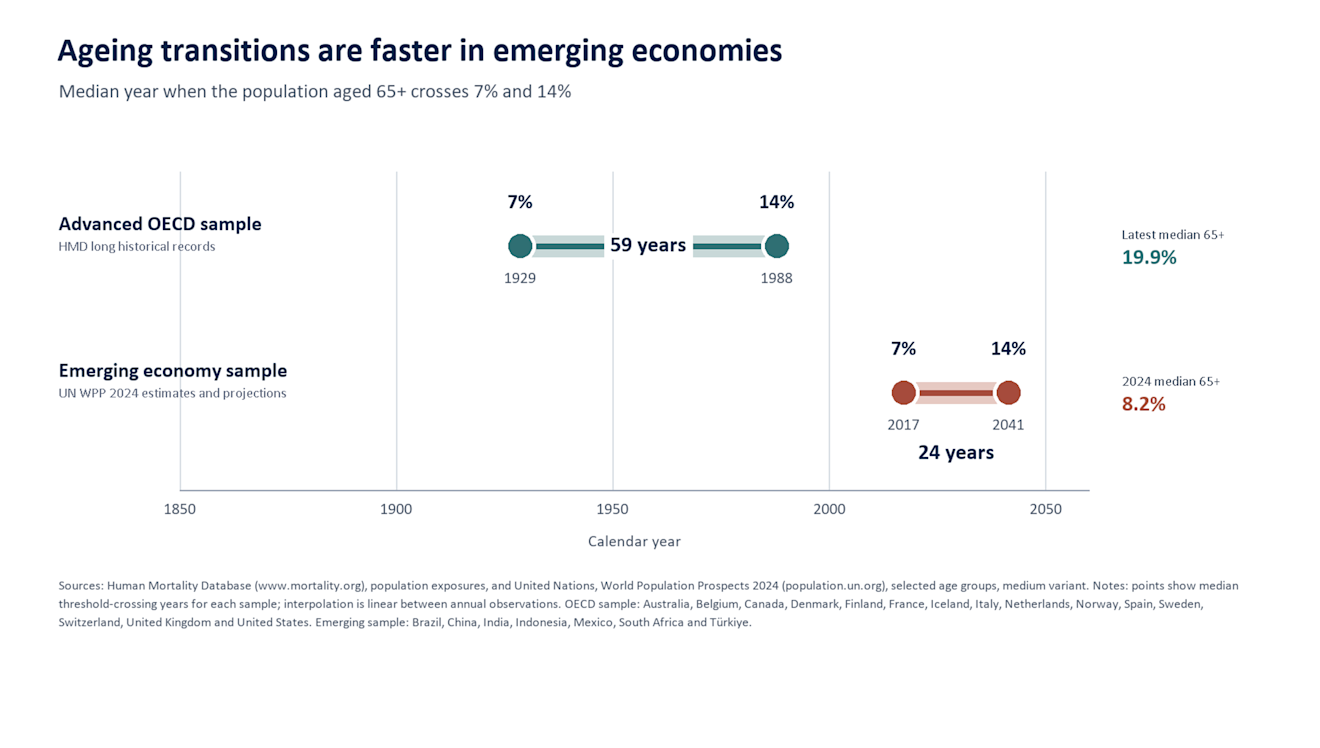
That speed matters. Pension providers, labour markets, annuity markets, supervisory capacity and social protection floors all take time to build. The lesson from advanced economies is not to copy today's architecture, but to design systems that can adapt before demographic pressure becomes difficult to manage.
Why longer retirements increase the role of saving
As longevity increases, the first years after retirement become more predictable. Most retired people at 65 will still be alive at 70, and many at 75 or 80. These are years for which resources should largely be accumulated in advance through individual accounts, occupational schemes or collective funded arrangements.
But insurance does not become obsolete. It becomes more valuable where risk is greatest. A person retiring at 65 does not know whether retirement will last 10 years, 25 years or 35 years. If individuals must finance the maximum plausible lifespan entirely through savings, some will consume too cautiously, while others may exhaust their assets.
Longevity pooling helps solve this problem. In a pool, resources associated with those who die earlier help finance pensions for those who survive longer. These mortality credits make it possible to finance advanced-age pensions more efficiently than requiring every individual to self-insure against extreme longevity.
Save for the likely years, insure the tail
This framing is well established in retirement-income literature. Milevsky (2005) describes advanced-life delayed annuities as longevity insurance with a deductible: households self-finance the deductible period and insure income only at advanced ages. Scott (2008) and Gong and Webb (2010) show that such products can deliver much of the longevity protection of immediate annuities at a lower upfront cost and with less loss of liquidity.
The policy design issue is therefore not only whether to annuitise, but when and how much. Blake, Cairns and Dowd (2003) frame defined-contribution payouts as a choice among annuitisation, invested drawdown and mortality-credit arrangements. Blake and Turner (2014) add that longevity insurance also depends on reserving rules, hedging instruments, provider solvency and public confidence.
Berstein and Morales (2021) illustrate this logic for defined-contribution pensions. Accumulated savings can finance early retirement years, when survival probabilities remain high, while deferred annuity income can be reserved for advanced ages, when survival is less likely and pooling is more valuable. The broader lesson is not country-specific: save for the retirement years most people will experience and insure against the unusually long retirement that individuals cannot efficiently finance on their own.
Designing for developing countries
For developing economies, there is no single optimal balance between saving and insurance. Where longevity at retirement is still relatively low, a larger share of old-age income risk retains an insurance character. As survival improves, more of retirement becomes predictable and the role of saving should increase. Insurance should remain focused on older ages, where uncertainty and dependency risks are concentrated.
Recent OECD work reaches a similar conclusion. OECD (2024) argues that defined-contribution payout frameworks should be built around retirees' financial needs and risks, combining regular income, liquidity and longevity protection according to context. OECD (2022) also highlights non-guaranteed lifetime income arrangements as a way to pool longevity risk, provided governance, regulation and communication are strong.
Three design principles follow.
1. Build adaptability into pension parameters. Retirement ages, contribution rates and the age at which longevity insurance begins should not remain disconnected from changes in life expectancy.
2. Introduce risk pooling before advanced-age survival becomes widespread. Financing late-life protection gradually over working life is easier than waiting until fiscal pressure is already visible.
3. Design for equity. Differences in life expectancy by income, education and occupation can make uniform pooling regressive unless benefit formulas, social pension floors or targeted protections are considered.
A System for Tomorrow's Longevity
The central policy choice is not between saving and insurance. Pension systems need both. As longevity rises, savings should finance a larger share of the retirement period that becomes predictable, while insurance should protect the uncertain and potentially costly tail of life.
For countries where longevity is still below advanced-economy levels but rising rapidly, the opportunity is to learn from history rather than repeat it. A pension system should not only be sustainable under today's longevity. It should be designed for tomorrow's.
Save for the years most retirees are likely to live. Insure the years that are hardest to predict and most expensive to self-finance. |
|---|
Use of AI assistance: The author used generative AI tools to support drafting, editing, literature identification and figure preparation. All data, references and conclusions were reviewed and verified by the author.
Written by:

Solange Berstein
Advisory Committee
Sign up for news and updates
The Coller Pensions Institute is part of the Jeremy Coller Foundation